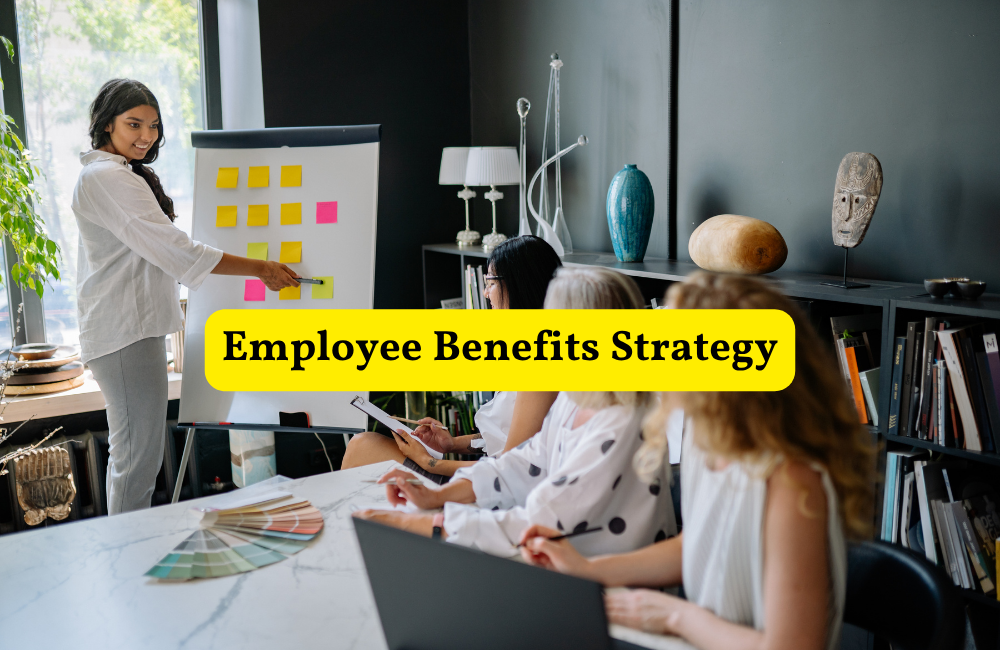
An employee benefits strategy is a structured approach to designing, managing, and improving the benefits an organization provides to its workforce. It goes beyond selecting health insurance at renewal time. A well-planned strategy connects healthcare costs, employee needs, recruitment and retention objectives, financial risk, benefits administration, and long-term business goals. JS Benefits Group helps employers approach benefits as an ongoing business strategy rather than a once-a-year insurance decision.
For many organizations, employee benefits become a priority only when renewal season arrives. Leadership receives new rates, HR reviews plan options, employees ask questions, and the company makes another annual decision.
That process can work for a straightforward benefits program. But as an organization grows, benefits become closely connected to broader business priorities.
Employees consider benefits when evaluating compensation. HR teams manage the administrative workload. Finance departments monitor healthcare expenses. Leadership considers how benefits affect recruitment, retention, employee satisfaction, and operating costs.
A strategic approach brings these considerations together.
The central question is no longer simply, “Which health plan should we choose?”
It becomes:
What should our benefits program accomplish for the business and its employees?
Begin With the Company’s Objectives
Every organization has different reasons for reviewing its benefits program.
One employer may want to control rising healthcare expenses. Another may need stronger benefits to compete for talent. A growing business may need more efficient enrollment and administration. An established company may want to improve employee affordability without sacrificing valuable coverage.
These goals can lead to very different benefits decisions.
Before reviewing insurance products, employers should identify their priorities. Those priorities may include:
- Managing healthcare costs
- Improving employee affordability
- Supporting recruitment
- Strengthening employee retention
- Providing competitive coverage
- Reducing administrative work
- Improving healthcare-cost transparency
- Managing financial exposure
- Increasing employee understanding of benefits
- Creating a more predictable benefits budget
Once the objective is established, potential changes can be evaluated based on whether they actually solve the organization’s problem.
Understand the Existing Benefits Program First
A benefits strategy should begin with an assessment of what the employer already has.
Knowing the annual premium is not enough.
Employers should understand employer and employee contributions, plan design, provider networks, prescription benefits, claims trends, utilization patterns, administrative performance, and employee feedback where appropriate.
This process can reveal whether the organization’s primary challenge is actually the insurance premium.
For example, rising healthcare costs may be associated with prescription spending, plan design, provider pricing, claims activity, or other factors. Each situation may require a different response.
An effective consultant does not begin with the assumption that the current plan needs to be replaced.
Sometimes the strongest strategy is to retain the existing structure and make targeted improvements.
Look Beyond the Premium
Healthcare costs are often discussed in terms of insurance premiums because premiums are easy to identify.
But the premium is only one part of the overall financial picture.
Healthcare spending can be influenced by claims, prescription utilization, provider networks, employee demographics, plan design, and the funding structure of the health plan.
For this reason, simply moving from one carrier to another may not address the underlying issue.
A more useful process asks:
Why are costs changing?
If prescription spending is increasing, pharmacy benefits may require closer analysis.
If employees are struggling with affordability, contribution structures and plan design may need attention.
If claims volatility is creating financial uncertainty, alternative funding may deserve consideration.
The strategy should respond to the cause rather than the symptom.
Employee Affordability Is Part of the Equation
Employers naturally focus on their own healthcare expenses, but employees experience benefits differently.
Employees see payroll deductions, deductibles, copayments, coinsurance, provider charges, prescription costs, and out-of-pocket maximums.
A strategy that reduces employer spending while substantially increasing employee costs may create unintended consequences.
Employee affordability does not necessarily mean minimizing every employee expense. Instead, employers should consider whether the contribution and cost-sharing structure provides reasonable value relative to the coverage offered.
The objective is balance.
Benefits Can Support Recruitment and Retention
Employee benefits are part of the broader total rewards package.
Candidates may consider health insurance, retirement benefits, paid time off, disability coverage, life insurance, flexibility, and other benefits when evaluating an employment opportunity.
The importance of each benefit depends on the organization’s workforce.
A company recruiting specialized professionals may have different benefits priorities from an organization employing a large hourly workforce.
This means employers should avoid copying another company’s benefits package simply because it appears competitive.
The better approach is to determine what the organization’s workforce values and which benefits support its recruitment and retention objectives.
Every Plan Design Involves Trade-Offs
There is no health plan that maximizes every desirable feature at the same time.
A plan with lower deductibles may cost more.
A higher-deductible plan may reduce premiums but increase employee exposure when healthcare is used.
A broader network may improve provider access while producing different pricing considerations.
Higher employer contributions may improve employee affordability while increasing company expenses.
These are strategic decisions.
Employers should understand why each trade-off exists and whether it supports the company’s objectives.
A well-designed plan is not necessarily the plan with the most benefits.
It is the plan whose cost and coverage structure make sense for the organization and its workforce.
Consider Alternative Funding When Appropriate
Some employers eventually explore funding models beyond traditional fully insured health insurance.
Level-funded and self-funded arrangements can provide alternative approaches to managing healthcare costs and financial risk.
Self-funded plans generally place more direct claims responsibility on the employer, while stop-loss coverage can help protect against certain levels of unexpected claims.
Level-funded arrangements generally combine a predictable payment structure with elements associated with self-funded financing.
Neither option is universally appropriate.
Employers considering alternative funding should evaluate financial capacity, workforce stability, claims experience, risk tolerance, administrative capabilities, and long-term objectives.
The purpose of the evaluation should be to determine whether the funding model fits the business—not to adopt an alternative structure simply because it is marketed as a cost-saving opportunity.
Give Prescription Benefits the Attention They Deserve
Prescription benefits are an important part of the overall healthcare strategy.
Drug spending can be influenced by formularies, specialty medications, pharmacy networks, utilization management, and pharmacy benefit arrangements.
Employers reviewing healthcare costs should therefore consider prescription benefits alongside medical coverage.
If pharmacy expenses are contributing significantly to overall healthcare spending, changing the medical plan alone may not solve the problem.
A complete benefits review looks at the entire healthcare ecosystem.
Evaluate Provider Networks From the Employee’s Perspective
Employees judge a health plan partly by whether they can actually use it.
A plan can appear attractive financially while creating frustration if employees cannot conveniently access their preferred physicians, specialists, hospitals, or other healthcare providers.
Employers should consider the geographic distribution of their workforce when evaluating networks.
Questions worth asking include:
- Where do employees live?
- Where do they typically receive medical care?
- Are important physicians and facilities available?
- Are employees likely to encounter out-of-network expenses?
- Does the network provide reasonable access for employees and dependents?
Provider access is not a minor detail.
It is part of the practical value of the health plan.
Communication Should Be Treated as Part of Plan Design
Even an excellent benefits program can underperform if employees do not understand it.
Health insurance terminology can be confusing. Employees may not understand the difference between deductibles, copayments, coinsurance, and out-of-pocket maximums.
They may also be uncertain about provider networks or prescription coverage.
Effective communication should therefore begin before enrollment and continue throughout the year.
Employees should understand:
- What their benefits cover
- What they are expected to pay
- How to use the plan
- Where to find benefits information
- How to resolve problems
- Who can assist them with questions
Clear communication helps employees make better use of benefits the employer is already funding.
Employee Advocacy Matters After Enrollment
Benefits support should not end when open enrollment closes.
Employees can encounter denied claims, confusing medical bills, prescription issues, provider questions, or other problems during the year.
Without dedicated assistance, these issues can quickly become HR responsibilities.
Employee advocacy provides another layer of support by helping employees understand their benefits and navigate problems.
JS Benefits Group includes employee advocacy within its broader benefits services.
For employees, this creates a resource when they need help.
For HR teams, it can reduce the amount of time spent resolving individual benefits questions.
Benefits Administration Needs a Sustainable Process
Administrative challenges often become more visible as companies grow.
Eligibility changes, enrollment elections, payroll deductions, employee communications, documentation, and vendor coordination all require accuracy.
Processes that work for a small workforce may become difficult to manage manually as the organization expands.
Benefits technology can help organize these responsibilities and create more consistent workflows.
JS Benefits Group incorporates benefits technology and enrollment support into its services, including Employee Navigator.
The objective should not simply be to introduce another technology platform.
The goal is to make benefits administration more accurate, efficient, accessible, and manageable.
Connect Benefits With HR Strategy
Benefits should not exist separately from human resources.
Recruitment can be influenced by the benefits package.
Retention can be affected by how employees perceive total rewards.
HR workload can increase when benefits administration is inefficient.
Employee relations can be affected when benefits questions are not handled effectively.
For organizations with limited internal HR resources, connecting benefits consulting with broader HR support can be especially useful.
JS Benefits Group provides services that extend into areas such as fractional HR support, compliance, recruiting, HR technology, benefits administration, and employee benefits.
This integrated approach allows organizations to consider benefits decisions in the context of their broader people strategy.
Build Compliance Into the Process
Benefits administration can involve significant regulatory and documentation responsibilities.
Depending on the employer and plan structure, considerations may include the Affordable Care Act, ERISA, COBRA, eligibility requirements, required notices, plan documents, and other administrative obligations.
Compliance should be considered when designing and implementing the benefits program rather than treated as an issue to address after a problem occurs.
Employers should also recognize when specialized legal guidance is necessary. Benefits consultants can assist with administration and identify potential concerns, while legal counsel should address legal interpretation when appropriate.
Measure Whether the Strategy Is Working
A benefits strategy should have measurable objectives.
Financial measures may include employer healthcare spending and employee contribution levels.
Operational measures can include enrollment accuracy, benefits-related workload, and recurring administrative issues.
Employee-focused measures may include participation, feedback, understanding of benefits, and recruitment-related observations.
Employers do not need an overly complicated measurement system.
They need enough information to determine whether the strategy is achieving its purpose.
If the goal was cost management, evaluate whether costs improved.
If the objective was better employee affordability, review employee contributions and cost-sharing.
If the goal was administrative efficiency, determine whether HR workload actually decreased.
Measurement turns benefits planning into an ongoing management process.
Common Mistakes Employers Should Avoid
Treating Renewal as the Entire Strategy
Renewal happens once a year. Strategic benefits management should happen throughout the year.
Selecting the Lowest-Cost Option
A lower premium can come with higher employee expenses, narrower provider access, or different coverage limitations.
Changing Plans Without Understanding the Cause of Rising Costs
A new carrier does not necessarily solve an underlying utilization or pharmacy issue.
Ignoring Employee Experience
Employees are the people using the benefits. Their ability to understand and access coverage matters.
Adopting Alternative Funding Without Understanding Risk
Level-funded and self-funded arrangements require careful consideration of financial exposure and contractual terms.
Overlooking Administration
A good plan can become difficult to manage if the employer lacks effective systems and processes.
Assuming Every Year Requires a Major Change
Sometimes improvement means refining the current strategy rather than replacing it.
A More Disciplined Annual Benefits Process
Employers can make benefits planning more effective by treating it as a continuous process rather than a renewal-season project.
Begin with the previous year’s results.
Identify changes in costs, claims, employee needs, workforce composition, and administrative performance.
Determine what worked and what did not.
Then identify the problems that genuinely require action.
Only after that should the organization begin comparing alternative plans, funding structures, vendors, or technologies.
This sequence helps prevent reactive decisions.
It also gives leadership more time to understand the consequences of major changes before implementation.
The Role of JS Benefits Group
JS Benefits Group approaches employee benefits as part of a broader business strategy.
Its services can encompass benefits plan design, healthcare cost management, carrier and vendor evaluation, alternative funding, pharmacy benefits, wellness programs, employee advocacy, benefits administration, benefits technology, and HR support.
This broader perspective can be useful when a benefits challenge affects multiple areas of the organization.
For example, rising healthcare costs may require plan-design analysis and funding evaluation.
Recruitment challenges may require a review of the total benefits package and employee communication.
Administrative problems may require improved technology and workflow design.
A growing organization may need benefits planning that aligns with broader HR development.
The advantage of this approach is that individual decisions can be evaluated within the context of the entire organization.
A Practical Framework for Better Benefits Decisions
Before making a major change, employers should be able to answer five questions:
What are we trying to accomplish?
Define the business objective before comparing products.
What is happening today?
Establish a baseline using available financial, utilization, employee, and administrative information.
What is causing the problem?
Separate the visible symptom from the underlying issue.
What trade-offs are acceptable?
Every benefits decision affects some combination of cost, coverage, employee contributions, risk, administration, and flexibility.
How will we measure success?
Determine in advance how the organization will know whether the change delivered the intended result.
This framework makes benefits decisions more deliberate and easier to evaluate.
Practical Takeaways for Employers
An effective employee benefits strategy does not start with a carrier, a renewal quote, or a promise of savings.
It starts with the organization.
Leadership should understand what the business needs, what employees value, what the current benefits program is accomplishing, and where the gaps exist.
From there, employers can evaluate plan design, healthcare costs, employee affordability, provider access, prescription benefits, funding structures, administration, technology, and HR support.
The right strategy may involve significant change.
It may also involve making smaller improvements to an existing program.
For JS Benefits Group, the objective is to help employers make those decisions based on their specific circumstances rather than forcing every organization into the same benefits model.
The strongest benefits program is not necessarily the largest or most complicated.
It is the one that employees can use, HR can manage, leadership can justify, and the business can sustain.