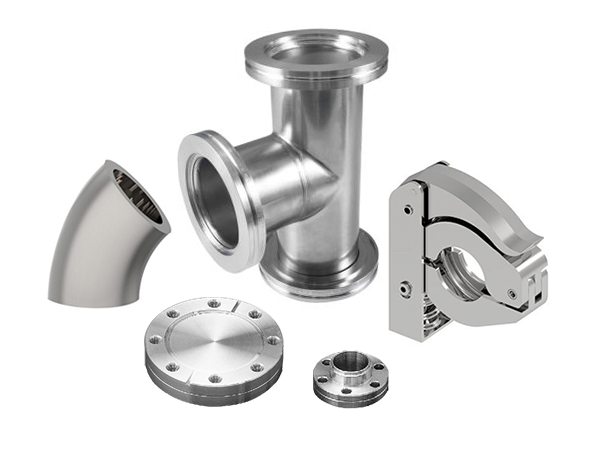
Building a high vacuum technology is like putting together a complex puzzle. Each piece must fit perfectly and work flawlessly. These pieces are high vacuum components. They are the pipes, valves, gauges, and seals that make a vacuum system function. Each component has a specific job. Together, they create and maintain the incredibly low pressures needed for many advanced technologies.
When we talk about high vacuum, every component matters. A single wrong choice or a small imperfection can prevent the system from reaching the desired vacuum level. Therefore, selecting and assembling these components requires care.
The Foundation: Vacuum Chambers
The heart of any high vacuum system is the vacuum chamber. This is the enclosed space where we create the low pressure environment. Vacuum chambers come in many shapes and sizes. Some are small, desktop units. Others are massive, room-sized structures.
Most high vacuum chambers are made from stainless steel. Why stainless steel? It is strong, resists rust, and most importantly, it outgasses very little. Outgassing is when materials slowly release trapped gases, like water vapor, into the vacuum. If a chamber outgasses too much, we cannot reach high vacuum. Special grades of stainless steel, like 304L or 316L, are preferred because they have low carbon content, which reduces outgassing.
The inside surface of a vacuum chamber is often electropolished. This process makes the surface incredibly smooth. A smooth surface holds fewer trapped gas molecules and is easier to clean, further reducing outgassing. Welds on vacuum chambers must be perfect. Any porosity or crack in a weld can be a leak path or a source of outgassing.
Connecting the Pieces: Vacuum Piping and Fittings
Vacuum chambers connect to pumps, gauges, and other parts through pipes and fittings. These connections must be leak-tight. In high vacuum, we do not use standard plumbing pipes. We use special vacuum-rated tubing and fittings.
Common materials for vacuum piping are also stainless steel. The tubing must be smooth inside and free of burrs or contaminants. Bellows, which are flexible sections of corrugated metal tubing, are often used. Bellows allow for slight misalignment between components and absorb vibrations from pumps.
The most critical part of vacuum plumbing is the fitting that connects pipes and components. For high vacuum, we mostly use two types of flanges: KF and ConFlat (CF). source smolsys.com
- KF Flanges: These are quick-release flanges. They use a centering ring with an O-ring (usually made of Viton or similar elastomer) and a clamp that pulls the two flanges together. KF fittings are good for pressures down to about 10−7 torr. They are easy to assemble and disassemble, which makes them popular for systems that need frequent changes or maintenance. The O-ring provides the seal.
- ConFlat (CF) Flanges: These are the workhorse for high vacuum and ultra-high vacuum applications. CF flanges use a soft copper gasket. When two CF flanges are bolted together, the copper gasket deforms and creates a metal-on-metal seal. This seal is extremely robust and can withstand high temperatures (important for baking the system to reduce outgassing). CF flanges are typically used for pressures below 10−7 torr and can go down to 10−11 torr or lower. They are much harder to assemble and disassemble than KF flanges, as they require many bolts and precise tightening. But their performance makes them essential for the lowest pressures.
All fittings, regardless of type, must be meticulously clean before assembly. Even a fingerprint can contain enough oil to cause outgassing problems.
Controlling Flow: Vacuum Valves
Valves control the flow of gas in a vacuum system. They allow us to isolate sections of the chamber, introduce gas, or connect/disconnect pumps. Just like other components, vacuum valves are specialized.
Common types of high vacuum valves include:
- Gate Valves: These valves have a flat plate (the gate) that slides across the opening to block gas flow. They offer a large opening when fully open, which helps with pumping speed. Gate valves are often used between the main vacuum chamber and the high vacuum pump. They can be manually operated or pneumatic (air-powered).
- Angle Valves: These valves have a body with a 90-degree bend. A plunger with a sealing pad moves up and down to open or close the flow. They are compact and provide a good seal. Angle valves are versatile and used for many applications, including isolating sections and introducing gas.
- Bakeable Valves: For ultra-high vacuum systems that require baking, valves must also withstand high temperatures. These valves use metal bellows instead of O-rings to provide a moving seal, as O-rings would degrade at high temperatures. The seals inside these valves are often made of metal, like stainless steel, and rely on precise machining for sealing.
Valve selection depends on the pressure range, temperature requirements, and the gas being handled. A valve that works well for rough vacuum will not work for high vacuum.
Knowing the Pressure: Vacuum Gauges
You cannot manage what you do not measure. Vacuum gauges tell us the pressure inside the system. Different pressure ranges require different types of gauges.
- Pirani Gauges: These are thermal conductivity gauges. They measure how well gas conducts heat away from a heated filament. More gas molecules mean better heat conduction and thus a lower filament temperature. Pirani gauges are good for rough and medium vacuum, from atmospheric pressure down to about 10−4 torr.
- Capacitance Manometers: These gauges measure pressure by sensing the change in electrical capacitance between a fixed plate and a flexible diaphragm. The diaphragm bends with pressure changes, altering the capacitance. They are very accurate and are independent of gas type. They measure from atmospheric pressure down to 10−5 torr.
- Ionization Gauges: These are the go-to gauges for high and ultra-high vacuum. They work by ionizing gas molecules and measuring the resulting ion current. More ions mean higher pressure. There are two main types:
- Hot Cathode Ion Gauges: A heated filament emits electrons, which ionize gas molecules. They measure from 10−3 torr down to 10−10 torr.
- Cold Cathode Ion Gauges (Penning Gauges): These use a magnetic field to create a discharge that ionizes gas. They are more robust than hot cathode gauges and measure from 10−2 torr down to 10−9 torr.
Choosing the right gauge is crucial for accurate pressure monitoring and process control. Often, a high vacuum system uses several different gauges to cover the full pressure range from atmosphere to high vacuum.
Sealing the System: Gaskets and O-rings
Seals are incredibly important. A vacuum system is only as good as its weakest seal.
- O-rings: These are circular rings, typically made of elastomers like Viton, Buna-N, or Kalrez. They fit into grooves between two components and are compressed to create a seal. O-rings are excellent for rough and medium vacuum and are used with KF flanges. However, they outgas significantly at very low pressures and cannot withstand high baking temperatures.
- Metal Gaskets: For high and ultra-high vacuum, metal gaskets are essential. Copper is the most common material. It is soft and deforms under pressure, creating a strong, permanent seal. Indium and aluminum are also used for specific applications. Metal gaskets are used with CF flanges and are bakeable. Once a metal gasket is used, it deforms, so it cannot be reused.
Introducing and Controlling Gas: Gas Inlet Systems
Many vacuum processes require introducing a specific gas at a controlled rate. This is done through a gas inlet system. These systems typically consist of:
- Mass Flow Controllers (MFCs): These devices precisely measure and control the flow rate of a gas. They are essential for processes like sputtering or chemical vapor deposition where the amount of reactive gas must be exact.
- Leak Valves (or Variable Leak Valves): These finely adjustable valves allow a small, controlled amount of gas to enter the vacuum chamber. They are often used for backfilling a chamber with inert gas or for controlled etching processes.
Supporting Equipment: Traps and Filters
To protect pumps and maintain cleanliness, various traps and filters are used.
- Cold Traps: These are placed between the vacuum chamber and the pump, especially for diffusion pumps. They use liquid nitrogen or other refrigerants to cool surfaces, condensing and trapping water vapor and other condensable gases before they reach the pump or contaminate the system. This speeds up pump-down and protects the pump.
- Foreline Traps: These traps are placed in the roughing line between the roughing pump and the high vacuum pump. They catch oil backstreaming from mechanical roughing pumps, preventing it from reaching the high vacuum side.
- Particle Filters: These filters prevent small particles from entering the vacuum system or from leaving the exhaust of a pump, where they could contaminate the environment.
Maintenance and Cleanliness
Even with the best components, a high vacuum system needs proper maintenance and cleanliness. Components must be clean before assembly. We avoid touching critical sealing surfaces with bare hands. We use lint-free wipes and special solvents to clean parts. Regular leak checking and preventative maintenance on pumps and valves ensure the system performs optimally.
High vacuum components are not just parts; they are precision instruments. Their design, materials, and assembly dictate the performance of the entire vacuum system. Understanding each component’s role and limitations is vital for anyone working with high vacuum technology. It is a field where attention to detail leads to success.